
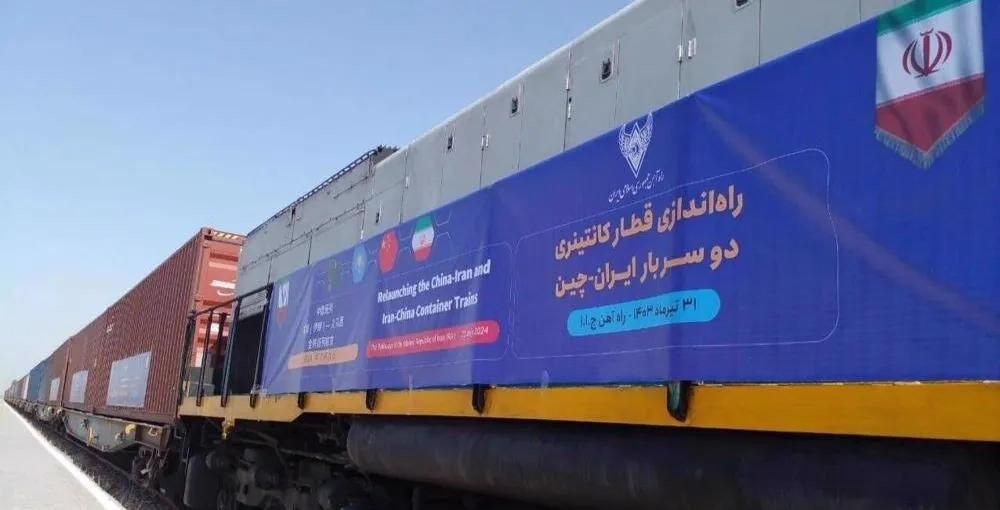
While maritime routes through the Persian Gulf remain constrained, the China–Central Asia–Iran rail corridor has quietly evolved from an alternative option into a load-bearing pillar of bilateral trade. Statements from an Iran Chamber of Commerce official this week give the clearest picture yet of the scale of that shift — and what it means for anyone planning shipping from China to Iran.
Several Freight Trains From China Now Enter Iran Every Day
Sadr al-Din Niavorani, deputy head of the Export Commission of the Iran Chamber of Commerce, told the Iranian business outlet Eghtesad 120 that freight trains from China to Iran now run several trips every day, with each train carrying roughly 60 wagons of about 70 tonnes each. In his view, it is this steady inflow that has so far prevented visible shortages of imported goods in the Iranian market. Source: Khabar Farsi / Eghtesad 120.
The number is remarkable in context. Before the Gulf crisis escalated in early 2026, international data indicated roughly one China-bound departure per week; by spring this had grown to one train every three to four days. The English-language outlet WANA, reporting the same remarks on September 7, described “several daily movements” of Chinese freight trains into Iran. Source: WANA News.
Why the Rail Corridor Has Become Strategically Important
Since the effective closure of the Strait of Hormuz to most commercial shipping, a meaningful share of China-Iran cargo has shifted to overland routings. The rail corridor enters Iran via Kazakhstan and Turkmenistan, crossing at the Inche-Buroun border point — deep inside Eurasia, where maritime interdiction simply cannot reach it.
That said, a dose of realism is needed: rail capacity is a fraction of what ocean carriers can move, and it cannot fully replace container shipping. Its real value is as a backbone backup — when sea lanes face delays, war-risk premiums and booking backlogs, rail keeps supply chains from seizing up entirely.
Rail vs Sea vs Air: Practical Comparisons
For an importer in Tehran evaluating China to Iran freight forwarding options, the practical trade-offs look like this:
- Transit time: Rail from hubs like Xi’an to Tehran takes about 15–23 days — faster than sea, which in current conditions can stretch to 40–50 days, but slower than air freight from China to Iran at 5–7 business days.
- Cost: Rail pricing typically sits between sea and air. For medium-value, high-volume cargo it offers the best balance of price and speed. A detailed cost breakdown for each mode is worth reviewing before committing.
- Reliability: Unlike sea freight tied to Hormuz conditions, rail schedules have stayed comparatively regular — easier to plan around.
Practical Recommendations for Importers
- Book earlier. Surging demand has tightened wagon and container space on rail. Reserve at least 2–3 weeks ahead of your target departure.
- Match the mode to the cargo. Urgent or perishable goods by air; heavy, lower-value goods by rail or sea; sensitive shipments by multimodal combinations. Our team can recommend the right mix for your SKU.
- Sort out customs before departure. Complete import registration, HS codes and standard-permit paperwork before the train moves, so cargo does not stall at the border. See our guides on Iran import regulations and customs clearance services.
- Build a multi-route plan. H1 2026 showed that importers dependent on a single corridor suffered the most. Combining rail, road freight, sea and air is the most resilient setup.
Conclusion
The surge in daily freight trains from China to Iran is genuinely good news for Iranian importers: even under the toughest geopolitical conditions, trade capacity exists and is expanding. China to Iran freight forwarding is no longer a simple “sea or air” decision — it is about building a multi-route logistics portfolio, and the forwarders who master that will serve their customers best.
For this week’s train schedules and a tailored quote, contact HamlChin or message us on WhatsApp.