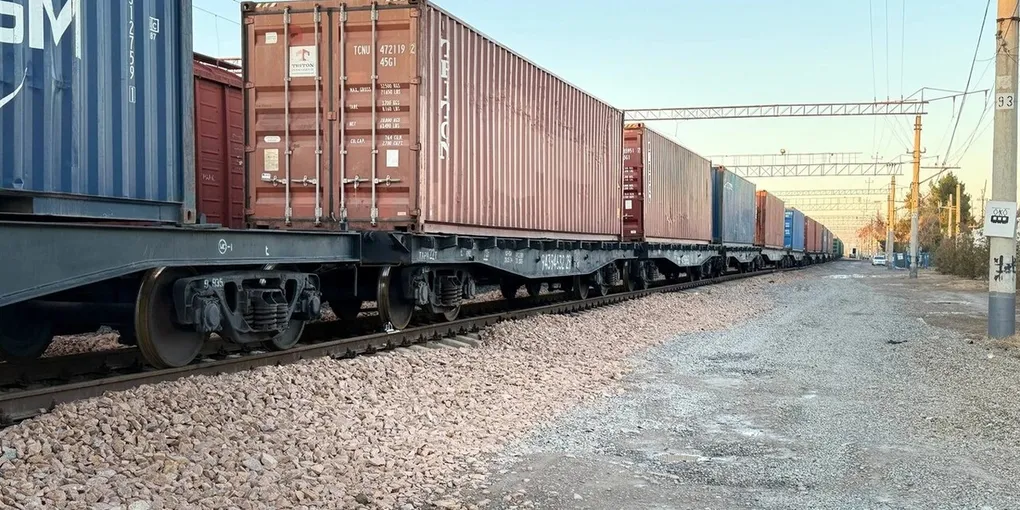
Uzbekistan’s state freight rail operator has announced a landmark development for overland trade: the first China–Iran block train — 55 container wagons — is moving through Kazakhstan, Uzbekistan and Turkmenistan as the opening move toward regular container services on the China–Central Asia–Iran transport corridor. For businesses evaluating shipping from China to Iran, this signals that the overland option is maturing from an emergency workaround into a scheduled commercial service.
Route and cargo details
According to Russian news agency Interfax, citing the Uzbek operator’s statement, the block train was formed at Chengxiang station in China and crossed into Kazakhstan at the Khorgos–Altynkol border crossing, departing Altynkol on September 7. The train is scheduled to enter Uzbekistan via the Keles border crossing, then continue through Turkmenistan via the Khojadavlet station, completing a journey of more than 6,000 kilometers with arrival in Iran expected around September 21. Source: Interfax.
Per the Uzbek statement, the train carries passenger-car components, consumer goods and other consolidated cargo, with a planned transit time of 14–16 days. Regional news agency Trend reported additional operational detail, noting that Kazakhstan Railways received the train at Khorgos–Altynkol and that the project is designed to serve as the basis for organizing regular container block trains along the corridor. Source: Trend News Agency.
Why this matters now
The Uzbek statement describes the shipment as confirming “the practical effectiveness of the China–Central Asia–Iran transport corridor.” Eurasianet, reporting on September 11, noted that with ship traffic around the Persian Gulf effectively paralyzed by the ongoing US–Iran conflict, the overland route has become a working alternative for Chinese-Iranian trade. Source: Eurasianet. Energy-market outlet OilPrice carried the same reporting, framing it as China’s growing Iran trade moving overland through Central Asia. Source: OilPrice.
In parallel, Iran has taken steps to ease maritime costs: the semi-official Fars news agency reported that Tehran temporarily suspended a 10 percent freight surcharge on foreign vessels carrying oil, gas and liquid petroleum products to or from Iran, aiming to lower transport costs and encourage foreign fleets back to Iranian ports. Source: Fars via Arab News.
What importers should take away
1. A credible middle option between sea and air. At 14–16 days transit, a block train sits well ahead of ocean freight on speed and well behind air cargo on cost — a strong fit for mid-value industrial cargo.
2. Less chokepoint exposure. Unlike the Strait of Hormuz, the Central Asian rail corridor is not subject to naval blockade, giving supply chains an extra layer of resilience.
3. Scheduling predictability. An officially announced plan for regular block trains means importers can plan inventory against a repeatable transit window rather than ad-hoc departures.
That said, the right mode still depends on cargo profile. Road freight offers door-to-door flexibility, while multimodal combinations can balance cost and speed. Accurate routing, duty calculation and customs clearance in Iran all benefit from specialist advice.
Which cargoes fit this corridor?
The declared cargo mix — auto parts and consumer goods — points to a sweet spot for automotive components, electrical goods, textiles and light industrial inputs. Before booking, review Iran’s restricted-items list and import regulations: prohibited and restricted items.
Bottom line
The first officially coordinated China–Iran block train marks the commercialization of the Central Asian overland corridor. We recommend importers compare all three modes — sea, rail and air — on total landed cost and delivery window before committing. Our team can run that comparison for your specific cargo.
For a tailored quotation and routing plan, reach us via the contact page — WhatsApp replies are typically within one business hour.