
What happened this week
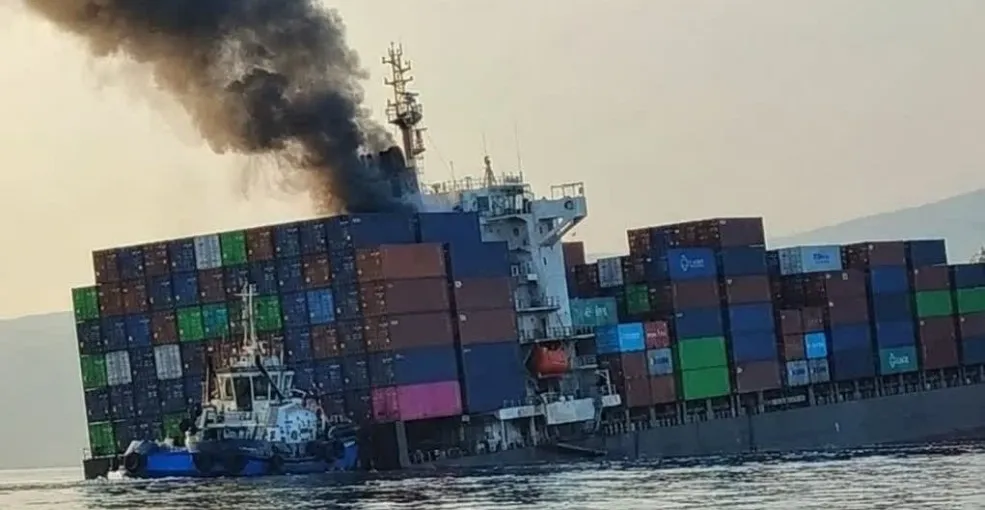
On October 13, the UK Maritime Trade Operations office (UKMTO) reported that four commercial vessels were struck by “unknown projectiles” in the Strait of Hormuz in a single day: the tanker Alfonso and the container ships Al Saadiyat, GFS Giselle and GFS Pride. A day later, the IRGC Navy announced that one of these vessels, carrying more than 2,500 containers, caught fire after hitting a naval mine and sank in the early hours of October 14. According to the statement carried by Xinhua, this is the first container ship to sink in the strait since the war began in late February.
Singapore’s Maritime and Port Authority confirmed that two Singapore-flagged vessels were hit while transiting; one sank, and its crew were evacuated before it went down with no reported injuries. The IRGC said the ship was using an “unauthorized and dangerous” route and warned nearby vessels about containers floating in the water. The incident came barely a week after our report on the tanker attacks, but the nature of the escalation has changed: container ships are now sinking.
Sea transit: from 20 days to three months
The numbers are blunter than the press releases. A deputy head of Iran’s Trade Promotion Organization said on October 6 (as covered by Iran International) that cargo moving from China to Tehran and other Iranian destinations now takes roughly two and a half to three months, up from 15 to 20 days before the war. This is not one carrier’s talking point; it is Iran’s official trade body briefing importers.
What does three months mean in practice? A shipment loaded in mid-August arrives in November under normal conditions. Importers who plan purchases around selling seasons need to redo the math on working capital, storage and contract deadlines.
Rates are holding high, and the peak may not be in
On the market side, the October 19 market wrap makes a few things clear: general-cargo vessels have been hit just as hard as tankers by the collapse in Hormuz transits; current freight costs remain below the post-pandemic peak, but diesel prices have hit fresh records and are feeding shipping costs higher; and there is a real risk that elevated rates become the new normal.
In plain terms, today’s prices are neither the floor nor, most likely, the ceiling. Budgeting on “wait for rates to fall” is a bet on a geopolitical concession, not on shipping market dynamics.
Where the land corridor stands
On rail, we published a detailed analysis last week: after the October 1 US sanctions on Islamic Republic of Iran Railways (RAI), the China–Iran trains kept running, but banks, insurers and document handlers around the route have turned more cautious, and cost and uncertainty have gone up.
On operating capacity, cargo trains from Xi’an to Tehran have been departing every three to four days since the US naval blockade began on April 13, each carrying around 50 standard 40-foot containers, a baseline Bloomberg disclosed in May that media outlets still cite today, which tells you the frequency has held. Door-to-port rail freight from China to Iran normally runs about two weeks, with Central Asian border congestion capable of adding another one to two. Against three months by sea, that window is still manageable. The trade-off is tight capacity and a rate curve that points up.
What to do this week
- Build sea shipments around a three-month transit. If a cargo has a fixed selling date, do not back-plan from the old 20-day figure.
- Move urgent replenishment by rail or air freight. Book rail slots two to three weeks out; departures close once trains are full.
- If you are waiting for the strait to reopen, set a hard decision point. Something like “if it is still closed in early November, we shift to rail”, and then actually follow through.
- Ask for surcharges in writing. War-risk insurance, deviation fees and port-change charges should appear as line items on the pro forma invoice; verbal assurances tend not to survive contact with the invoice.
Bottom line
The defining event this week was not another attack notice. It was the first fully laden container ship going down in Hormuz waters. The sea leg is not coming back on any reliable schedule, and rail-plus-road is now the only dependable option for shipping from China to Iran. To compare current China–Iran freight costs and transit times across rail, road and air, see our guide; for shipment-specific routing, reach us on WhatsApp.