
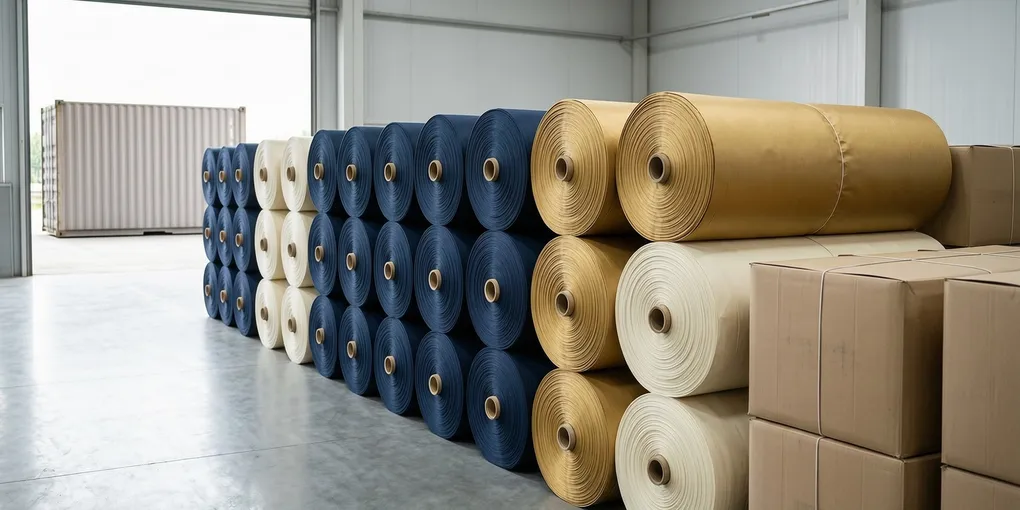
Iran’s garment plants in Yazd and Kashan, the curtain and bedding makers around Isfahan, and the mid-sized weaving workshops that run orders of a few thousand metres all buy their fabric from the same place. Synthetic woven fabric is the single largest fabric category entering Iran: customs figures put polyester and other synthetic woven fabrics (HS 5407, 5408, 5512 to 5516) at more than 126,000 tonnes and roughly USD 724 million in a year, with knitted fabrics and coated fabrics adding separate markets of their own.
This guide covers the four decisions that decide whether the shipment makes money: where to buy, what to put on the proforma invoice, how the freight will actually be calculated, and what the customs lab does to your schedule.
Why Chinese polyester still sets the price
Range is the first reason. A single sourcing trip can cover 50 g/m² pocketing, 120 g/m² taffeta for outerwear, 180 g/m² satin for curtains and 400 g/m² PU-coated upholstery. A buyer running several product lines rarely finds that spread in one country anywhere else.
Lead time is the second. Stock shades ship in seven to fifteen days; custom dyeing usually takes twenty to thirty-five days. For a garment producer working to a selling season, that gap decides whether the collection lands on the shelf.
Order size is the third. Chinese mills quote from three to five thousand metres upward, which keeps a workshop in the market while it is still testing colours and constructions. European mills generally will not open a production slot at that volume.
Four sourcing hubs
Where you buy matters more than the first price you are quoted.
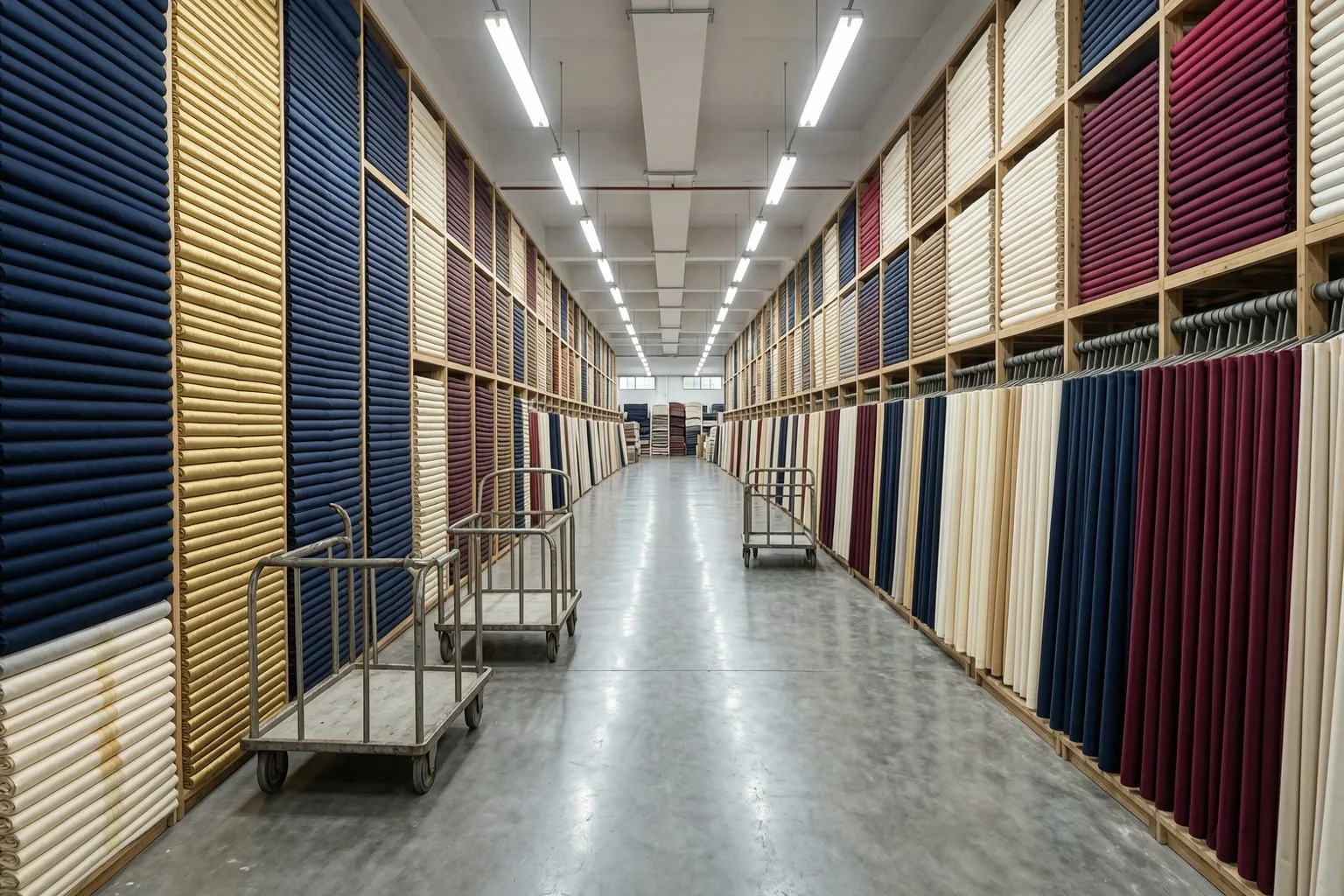
Keqiao, Shaoxing (Zhejiang). China Textile City is the largest fabric wholesale market in the world, with over three million square metres of trading space and tens of thousands of stalls grouped by product. You see and handle the cloth, compare shades roll to roll and buy the same day. The limitation is that custom grammage or a specific dye lot goes back to a mill, so the market is best for stock fabric.
Shengze, Wujiang (Suzhou). China’s filament polyester weaving base, built around mills rather than stalls. Above roughly 20,000 metres this is usually the better price, and grammage, width and warp density can be specified exactly. It sits about 130 km from Shanghai port.
Changshu (Jiangsu). Focused on weft-knitted and circular-knitted fabric, jersey, sports knits and jacquard. If your product is knitwear rather than woven, start here.
Guangzhou, Zhongda market. The largest fabric market in southern China. Wide variety at small volume, useful when you want a few hundred metres of several designs, or when fabric needs to consolidate with other cargo. Freight options from this city are covered under shipping from Guangzhou to Tehran. Yiwu also carries fabric alongside general merchandise and can fold it into one consolidated shipment, as described in the Yiwu LCL guide.
The spec sheet that prevents disputes
Most claims trace back to a thin proforma invoice. Eight fields belong on it.
| Field | Unit | Why it matters |
|---|---|---|
| Weight | g/m² (GSM) | The core value driver and the easiest thing to short |
| Full and usable width | cm | A 150 cm full width is usually 145–148 cm usable; price per usable metre is what counts |
| Yarn and denier | filament or staple, 75D/150D/300D | Denier drives strength and price |
| Fibre content | % polyester, viscose, elastane | The customs lab tests exactly this; any mismatch becomes a penalty |
| Construction | taffeta, satin, crepe, knit, jacquard | Determines tariff line and end use |
| Finish | piece-dyed, printed, PU/PVC coated, water-repellent | Coated fabric moves to a different tariff line |
| Roll length and rolls per bale | m, pcs | Basis for delivery count and volume |
| Dye lot number | mill code | Shade variation between lots ruins a production run |
Ask for shrinkage percentage and colourfastness grade separately. Those two numbers are what Iran’s standards lab measures, and the tariff and duty framework around them is summarised in the customs tariff guide.
Meter pricing versus kilo pricing
Chinese suppliers quote either per metre or per kilogram, and each hides a different problem.
Under metre pricing the risk is short weight: you order 120 g/m², the cloth arrives at 105 g/m². The surface looks fine, twelve per cent of the value is gone, and the garment maker discovers it a month later. Under kilo pricing the risk is short length: rolls of 95 metres instead of 100, with total weight still correct.
The check costs nothing. Cut one square metre and weigh it on a precise scale; at a declared 120 g/m² that square should weigh about 120 grams. Measure the length of five to ten rolls rather than all of them. Between them, those two checks catch most of what goes wrong.
To compare a metre quote against a kilo quote, normalise:
Price per kg = price per metre ÷ (usable width in m × grammage in kg)
A fabric at USD 1.80 per metre, 1.48 m usable, 0.12 kg per square metre, works out to about USD 10.1 per kg. Without that conversion, the cheapest quote is frequently not the cheapest cloth.
Why fabric freight is always billed by volume
Fabric is light and bulky, and that one fact drives the whole freight calculation. Carriers rate on W/M: one tonne equals three cubic metres, so cargo starts being charged on weight only above a density of roughly 333 kg/m³. Rolled polyester typically sits between 100 and 180 kg/m³, and even heavy upholstery rarely passes 250. Fabric therefore moves as measurement cargo almost every time, even when you bought it by weight.
The volume estimate is simple. A 100 m roll at 155 cm width has a diameter near 28 cm, which is about 0.1 m³. So roughly 1,000 metres of 120 g/m² fabric fills a cubic metre.
Worked example:
- 30,000 m of 120 g/m² taffeta at 150 cm width, about 5.4 tonnes
- Raw roll volume, about 30 m³
- Real stowage volume after loading losses, 35 to 40 m³
A 40-foot high cube holds about 68 m³ and a 20-foot about 28 m³. At 5.4 tonnes the cargo never approaches a container’s weight limit, so the 40HQ is the right box and a 20-foot wastes capacity. The rule of thumb: while density stays under 300 kg/m³, one large container beats two small ones on cost per metre.
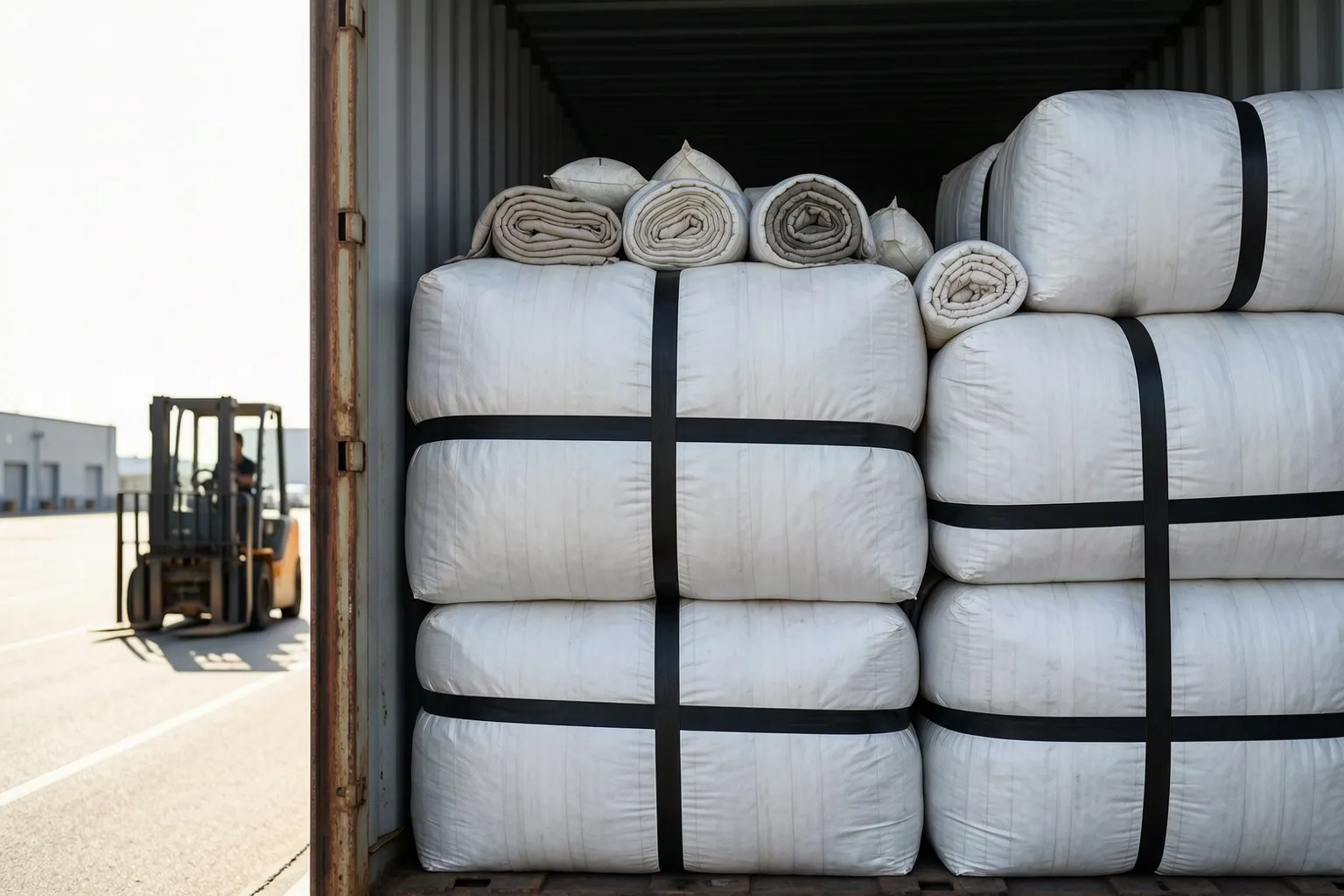
Two actions cut the bill directly. Baling rather than shipping loose rolls compresses volume by 25 to 35 per cent, and on measurement cargo that is the only real saving available. Choosing between LCL and FCL matters too: from about 12 to 15 m³, roughly 12,000 to 15,000 metres of light fabric, a full container is usually cheaper than groupage. Both services are described under FCL sea freight and LCL sea freight, and rate logic is explained in the China–Iran sea freight cost guide.
Three corridors out of Keqiao
Sea via Ningbo or Shanghai. Keqiao to the Ningbo terminal is two to three hours by truck; Shengze to Shanghai is about three. Normal door-to-door to Bandar Abbas runs 30 to 45 days including clearance. The 2026 Hormuz situation has stretched some ocean shipments to two or three months, so plan production against the pessimistic case and follow the Hormuz transit disruption report.
Rail via Yiwu or Xi’an. Keqiao to the Yiwu rail terminal is about two hours by road, and the train reaches Tehran in 18 to 25 days independent of the strait. Fabric is neither perishable nor temperature-sensitive, which makes rail a comfortable fit; see rail freight from China to Iran.
Road via Khorgos. Ten to fifteen days to Tehran for five to ten tonnes. The most expensive option, justified only when a delay costs more than the truck. Details under Khorgos–Tehran and road freight. Where you want one contract from mill gate to warehouse door, door-to-door shipping combines carriage and clearance.
Customs clearance: where the time goes
Fabric is one of the more closely examined import categories in Iran, and most of the delay happens here rather than at sea.
Before shipping, register the order. No order registration in the Comprehensive Trade System, and no product ID, means the cargo sits at the border. The registration date must precede the shipment date; that sequence cannot be fixed afterwards. See Iran import regulations.
Currency allocation. Each tariff line carries a priority group that determines the currency queue. Lines with domestic equivalents face tighter allocation, and that queue can move a purchase programme by weeks. Resolve the currency position before paying the mill deposit.
Sampling and laboratory testing. Fabric consignments are sampled at the border and tested to confirm fibre composition, grammage, width and construction against the declaration. Two practical consequences follow. The declared specification has to match what the lab finds, because a mismatch turns into a valuation dispute and a fine. And under a directive issued in Ordibehesht 1404 (spring 2025), the practice of releasing 90 per cent of a fabric consignment before results was suspended, so the whole shipment waits. Budget one to three weeks of storage. We handle this stage under Iran customs clearance.
Valuation. Customs cross-checks the declared value against its reference value database. Polyester fabric prices vary widely, so a declaration well below the reference reads as under-invoicing. A genuine proforma invoice and a documented bank payment are the defence.
Tariff lines and prohibitions. Synthetic filament woven fabrics sit in Chapter 54 (5407), staple fibre fabrics in 55 (5512–5516), coated fabrics in 5903 and knitted fabrics in 6001–6006. Duty rates differ sharply between these lines, so take the rate of the day from a broker rather than a table found online. One rule is absolute: used fabric and used clothing cannot be imported. The wider list is in prohibited and restricted items.
Packing: moisture is the real risk
Polyester absorbs less water than cotton, but water staining on pale shades is permanent and container sweat on a sea voyage is the most common cause of loss on this cargo.
- Bag every roll in polyethylene and seal both ends; keep the cardboard or plastic core in place.
- Bale rather than ship loose, using woven PP and steel strapping at 200 to 300 kg per bale. It cuts volume and speeds handling.
- Wooden pallets need the ISPM 15 mark; Iran will not admit untreated wood.
- Desiccant at roughly one 1 kg bag per five to ten cubic metres, plus a kraft paper layer over the stow.
- Keep cargo 10 to 15 cm clear of container walls and doors, where condensation collects.
- Label every bale with lot, grammage, length and colour. Without it, delivery counting and damage claims collapse.
- Insure all risks at real value. Moisture damage is only recoverable through insurance.
FAQ
What is an economic minimum order?
For LCL, three to five thousand metres is the practical floor; below that, fixed warehouse and documentation costs dominate the invoice. For FCL, the threshold is around 12,000 to 15,000 metres of light fabric.
How many metres fit in a cubic metre?
About 900 to 1,000 metres of 120 g/m² fabric at 150 cm width. Heavier or wider fabric gives less. Baling adds twenty to thirty per cent to that capacity.
Which grammage sells in Iran?
110 to 160 g/m² for outerwear, 150 to 200 for curtains, 250 and above for upholstery. Approve a physical sample before any bulk order; the right answer depends on your end market and price point.
How long does clearance take?
With complete documents and a clean lab result, one to three weeks from vessel arrival. A declaration error or grammage mismatch adds weeks and storage cost.
Can used fabric be imported?
No. Used fabric and used clothing are prohibited, and the consignment will be stopped and returned.
Sea or rail?
Sea is cheaper at volume and for long planning horizons. For a season that cannot absorb Hormuz risk, rail at 18 to 25 days is the safer schedule.
What decides the margin
Chinese polyester gives Iranian buyers range, small order sizes and short lead times. The margin, though, is settled before payment: a complete spec sheet, volume calculated rather than assumed with baling to compress it, and the currency and tariff position confirmed before the cargo moves. Everything after that is disciplined inspection and packing.
Send the volume, grammage and destination through the quote form or WhatsApp and we will price the shipment.