
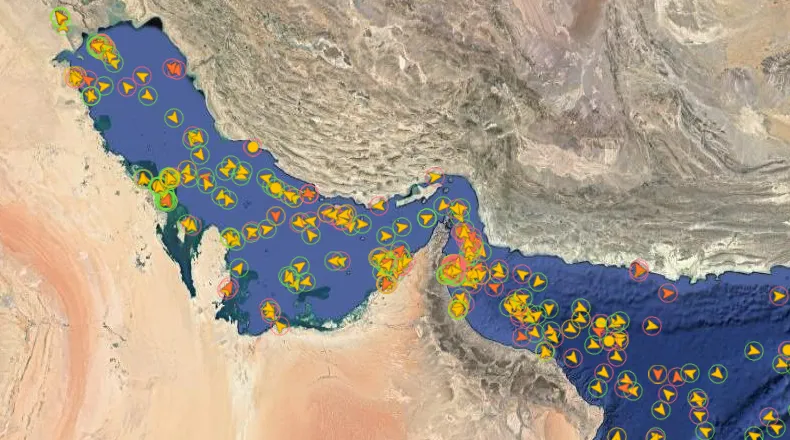
The past week brought a rare double blow to maritime trade between China and the Gulf: the Strait of Hormuz remained effectively half-closed while Houthi advances along Yemen’s Red Sea coast put the Bab al-Mandeb chokepoint — the main detour — under fresh threat. For Iranian importers the takeaway is blunt: the cost of shipping from China to Iran is approaching an all-time high.
Container rates have quadrupled
According to freight-pricing platform Xeneta, cited by Iran International in its September 18 report, spot rates on key routes out of China reached $10,948 per 40-foot container — more than four times the level before the war began on February 28. Xeneta chief analyst Peter Sand noted rates sit just below the all-time high of $11,900 set in January 2022, and could exceed it as bunker surcharges feed through: very low sulfur fuel oil has jumped from $543.50 to over $901 per metric ton. Source: Iran International.
Operational data confirms the stress: preliminary ship-tracking figures cited by Reuters show only three commercial vessels transited Hormuz on one day this week, versus a 10-day average of roughly 17.
What China asked of Tehran
On September 16, Iran’s foreign minister met his Chinese counterpart in Beijing. Wang Yi publicly called for the early reopening of the Strait of Hormuz, safe navigation and stable energy supplies. But Reuters, citing three Iranian sources, reports Beijing’s private message went further: after Houthi advances around Bab al-Mandeb, Saudi Arabia appealed directly to China, and China asked Tehran to use its influence to keep the fighting from spreading across the energy routes on which its economy depends. Source: Reuters / Dunya News.
The stakes are visible in one number: per Kpler data cited by Reuters, China buys more than 80% of Iran’s seaborne oil exports — about 1.4 million barrels per day — and has been Iran’s largest trading partner for over a decade.
What changed for importers this week?
1. High rates are no longer “temporary.” Buyers waiting for a quick normalization should re-plan on the assumption that elevated rates persist into Q4. Our 2026 sea freight cost guide breaks down how FCL/LCL pricing is built.
2. Route choice matters more than ever. Depending on the origin port, FCL container shipping from Shenzhen or Guangzhou to Bandar Abbas and LCL groupage offer meaningfully different cost-time trade-offs.
3. Overland alternatives are real, not theoretical. The rail option has quietly scaled up: freight trains from China now enter Iran several times a day, and the first China–Iran block train via Central Asia is due in Iran within days. For time-critical cargo, air freight from China to Iran delivers in 5–7 business days, while road freight via Central Asia lands in the sweet spot between cost and speed.
Three practical moves for this week
First, lock rates now for any cargo already in motion — bunker and war-risk surcharges are still being layered onto base rates. Second, build your landed-cost model with current exchange rates and full customs duty and tariff figures, not last quarter’s. Third, evaluate multimodal routings for new orders; rail plus final truck delivery often beats a full ocean container on total cost right now. Our team can support customs clearance at all Iranian ports, from Bandar Abbas to Tehran.
Bottom line
This is not a one-off spike. Months of conflict at both ends of the Arabian Peninsula have pushed China–Iran freight into a risk-priced regime. Importers who activate alternative corridors early will beat their competitors on both cost certainty and delivery reliability.
For today’s rates and a free routing consultation for your cargo, reach us via the contact page — our team typically replies within an hour.